For HubSpot · Founding Edition

Decide how leads move through HubSpot — before anyone builds it.

A bounded, build-ready specification for your Contact lifecycle, qualification, routing, ownership, SLA, exceptions, reporting, and QA — so the portal does what your team actually agreed to.

$349 founding price 3-business-day target after fit limited founding slots

Illustrative diagrams — not a client result. KRS is independent and not affiliated with HubSpot, Inc.

Lifecycle & routing specKRS-HS-001
STAGE 01 Subscriber STAGE 02 Lead MQL · NOW MQL STAGE 04 SQL STAGE 05 Opportunity STAGE 06 Customer AC Contact · Acme declared fields complete ROUTE ordered rules Owner · AE West assigned + notified SDR queue round-robin SLA 2h · escalate timer + fallback owner DECLARED CONFIG → stage · owner · SLA → VERIFIED BUILD PLAN

Illustrative — the Blueprint documents these decisions for your declared setup.

Why it matters

If lifecycle and routing aren't decided, HubSpot decides for you.

Every portal answers these four questions somehow — through defaults, one-off workflows, and tribal knowledge. When they aren't written down, the answers drift and revenue leaks between the cracks.

Without a blueprint
Which lifecycle stage is this — and why?Stages mean different things to different teams, so the funnel stops reconciling.
Who owns this contact right now?New leads land unassigned or bounce between reps; follow-up slips.
What's the SLA, and when does it escalate?Timers live in people's heads, not the workflow — so nothing escalates.
What actually counts as qualified?Scoring and hand-raise rules conflict, so “MQL” means whatever the last edit said.
With the Blueprint
Six stages with countable entry criteriaOne definition per stage, written so a builder can implement it exactly.
Ordered routing to named owner groupsEvery contact resolves to an owner, a queue, or a defined exception path.
SLA timers and escalation boundariesResponse windows and fallbacks encoded as rules, not reminders.
Qualification logic anyone can verifyExplicit criteria for qualified, unqualified, and review — with test cases.

The result: one specification your HubSpot builder can implement and your team can test — decided on paper, before a single workflow is touched.

Deliverable 01 · Lifecycle map

Every stage, with criteria a builder can implement.

No more “what does MQL mean here?” Each stage gets an entry rule, a source of truth, and a defined path for contacts that don't fit.

  • Forward progression — the criteria that move a contact to the next stage.
  • ?
    Unresolved transitions — where contacts stall today, made explicit and handled.
  • Sources of truth — which field or event decides each stage change.
LIFECYCLE MAP · CONTACT Subscriber entry: form submit, no consent to sales Lead entry: marketing consent + valid email MQL entry: score ≥ 60 OR demo request SQL entry: accepted by sales within SLA Opportunity entry: deal created + stage ≥ discovery Customer entry: closed-won on linked deal UNRESOLVED Lead with score 45 + demo request → which stage? The map decides, once.
ROUTING · ORDERED DECISION ROWS R1 named account? → AE owner Owner · AE West R2 territory = West + < 200 emp? → SDR SDR queue · RR R3 no email or missing country? → review Exception R4 default → nurture + fallback owner Nurture SLA 2 business hours unactioned → reassign to fallback owner + notify manager First matching row wins. Every contact resolves — no silent drop-offs. OWNERSHIP + SLA · DECIDED IN ROWS, NOT MEETINGS
Deliverables 04–05 · Routing & SLA

Ordered rules that always resolve to an owner.

Routing is written as decision rows a builder reads top to bottom — first match wins. Ownership, SLA timers, and escalation are part of the same table, so nothing lands nowhere.

  • 1
    First-match logic — deterministic order, defaults, and fallbacks.
  • SLA + escalation — response windows and what happens when they're missed.
  • !
    Exception paths — missing data and edge cases handled on purpose.
What's inside

Nine deliverables, in three phases.

Define the structure, decide the routing, verify the build — every artifact uses the same bounded decisions and identifiers.

Define — the structure
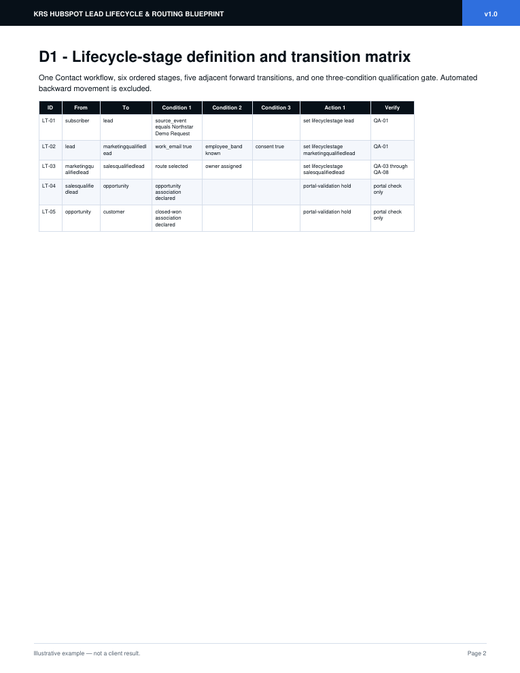
01Lifecycle mapStages, entry criteria, forward progression, and unresolved transitions.
02Data contractRequired Contact fields, allowed values, sources of truth, and validation.
03Qualification logicCountable criteria for qualified, unqualified, and review states.
Decide — the routing
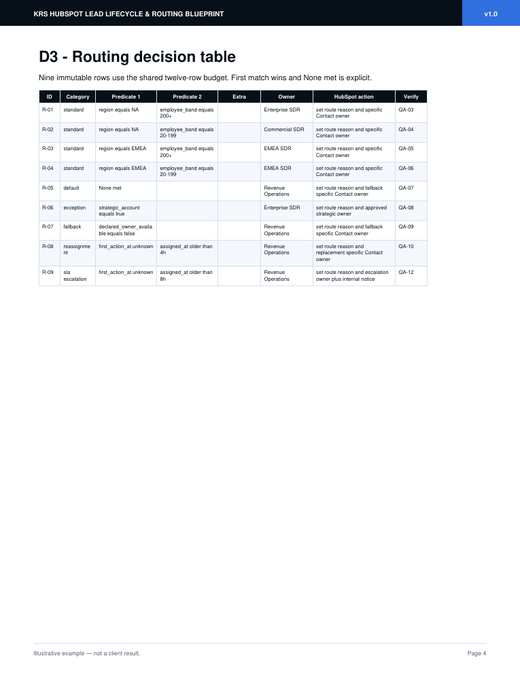
04Routing rulesOrdered decision rows, defaults, fallbacks, and ownership outcomes.
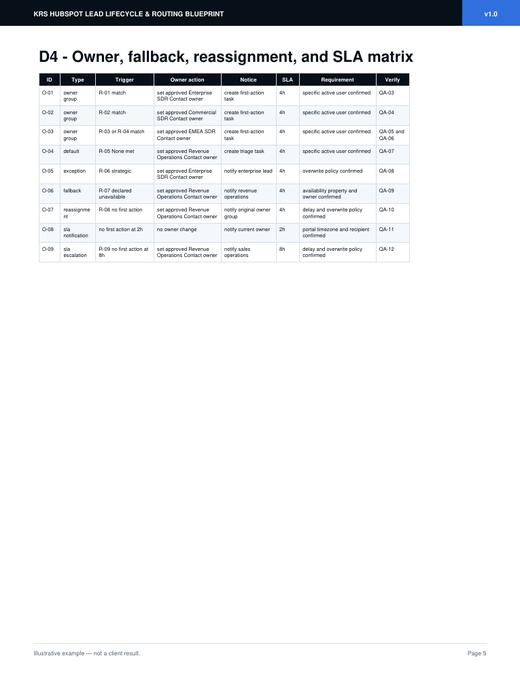
05Ownership & SLANamed owner groups, reassignment, timers, and escalation boundaries.
06Exception pathsMissing-data, unsupported-entitlement, and manual-review handling.
Verify — the build
07Reporting specEight bounded metrics with grain, filters, owners, and verification notes.
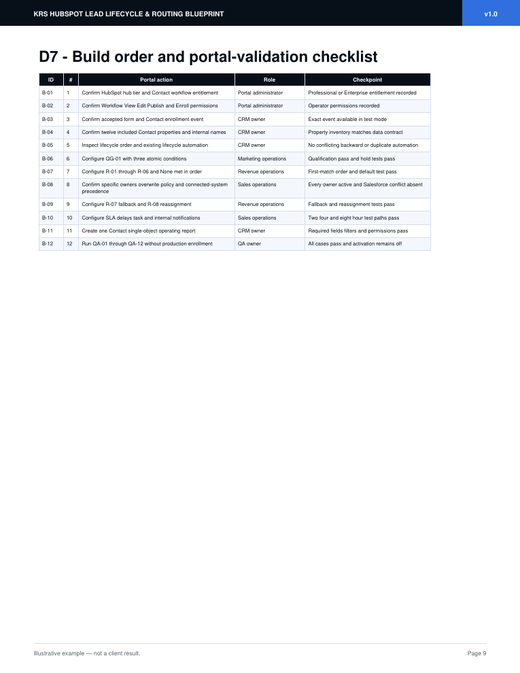
08Build orderA sequenced implementation checklist with portal-validation stops.
09QA planTwelve synthetic test cases covering normal, default, fallback, and exception behavior.
A product, not an open-ended project

Bounded on purpose, so it stays implementable.

The shared caps keep the decision package reviewable, testable, and usable by any HubSpot builder.

Contact-onlyUp to 6 lifecycle stages12 shared decision rowsUp to 4 owner groups12 QA casesOne correction round
Portal validation is required before implementation. This product is based on your declared configuration — it does not access, inspect, or change your HubSpot account.
How it works

From declared state to verified build plan.

1Complete structured intakeShare your declared lifecycle, qualification, routing, ownership, SLA, reporting, and current constraints.
2Receive the BlueprintGet the nine-deliverable package: a versioned PDF, editable sources, a manifest, and the QA plan.
3Validate before deploymentTest the specification against your licensed portal, permissions, internal names, and live requirements.
See the output

Read the full sample before you buy.

An 11-page fictional Blueprint showing the exact structure, level of detail, assumptions, and decision outputs — using wholly fictional data.
Open the 11-page sample
Lifecycle map sample page
Lifecycle mapStages and transitions
Routing rules sample page
Routing rulesOrdered logic + defaults
Ownership and SLA sample page
Ownership & SLAOwner groups + timers
QA plan sample page
QA planCases that verify behavior
Boundaries, up front

Questions worth answering before you apply.

Will you access or change my HubSpot account?

No. The Blueprint is based on your declared configuration and first-party documentation. It does not require credentials or production access. Portal validation is required on your side before implementation.

How is this different from custom consulting?

The founding product is intentionally bounded: one Contact path, countable decisions, nine required deliverables, one correction round, and an explicit change-order boundary. It's a specification, not an open-ended engagement.

What if my needs exceed the published scope?

The fit review pauses or declines work that needs additional objects, integrations, nested logic, custom code, or scope beyond the stated caps. Those needs require a separate engagement.

What happens after I validate the Blueprint?

The package becomes the decision specification for an authorized HubSpot build. Implementation is not included in this product, and the separate Rescue service is not currently available.

Apply

Apply for a founding Blueprint.

Founding slots are limited. After a quick fit check against the bounded scope, KRS sends a secure Stripe payment link — no charge before fit is confirmed.

$349 founding price 3-business-day target after acceptance
  • No charge until fit is confirmed against the published scope.
  • No portal access — the spec is built from what you declare.
  • See the full 11-page sample before you decide.

Bounded scope: Contact-only, up to 6 lifecycle stages, 12 decision rows, 4 owner groups, 12 QA cases, one correction round. Application information is handled under the Privacy Notice.